Blog • Football Performance

Speed & Acceleration Training for Footballers

Learn how footballers can improve acceleration, sprint mechanics, strength and power to become faster and more effective during decisive actions on the pitch.

Acceleration Sprint Mechanics Strength & Power
Understanding Football Speed

Acceleration vs Maximum Speed in Football

A player can be fast over 30 metres and still struggle to create separation in the first few steps. In football, acceleration and maximum speed are related but different qualities, and both have a place within a complete speed programme.

01

Acceleration

Acceleration is the ability to increase running speed rapidly from a stationary position or from a slower movement.

In football, this is important when a player reacts to a loose ball, presses an opponent, attacks space, makes a short run behind the defensive line or begins a recovery sprint.

Effective acceleration relies on the ability to apply force quickly while projecting the body forwards during the early steps.

02

Maximum Speed

Maximum-speed running happens later in a sprint, once the athlete has already accelerated and reached a much higher running velocity.

Players may reach these speeds during longer recovery runs, counter-attacks, runs into open space or transitions where more distance is available.

At higher speeds, mechanics change and the athlete becomes more upright, with greater emphasis on efficient force application and rapid ground contacts.

Football Application

Because many football actions begin over short distances, the ability to accelerate effectively through the first 5–10 metres is especially valuable. Maximum-speed exposure still matters, but footballers should not treat every sprint session as the same type of training.

Match Performance

Why the First 5–10 Metres Matter in Football

Football rarely gives a player unlimited space to build speed. Many important actions begin with a reaction followed by a short, aggressive movement. Being effective over the first 5–10 metres can influence whether a player reaches the ball first, escapes pressure or recovers defensively.

01

Create Separation

An explosive first few steps can help an attacker move away from a defender, attack space or gain the small advantage needed to receive the ball under less pressure.

02

Press & Recover

Defenders and midfielders repeatedly accelerate when closing down opponents, covering space and reacting after possession changes. The ability to produce speed quickly is therefore valuable on both sides of the ball.

03

React to Transitions

Football changes quickly. Counter-attacks, loose balls and defensive transitions often require players to accelerate immediately rather than gradually build towards maximum speed.

Coaching Perspective

The aim is not simply to make a player look fast during a straight-line sprint test. Football speed should transfer to football actions — reacting, accelerating, competing for space and being able to repeat those movements throughout training and matches.

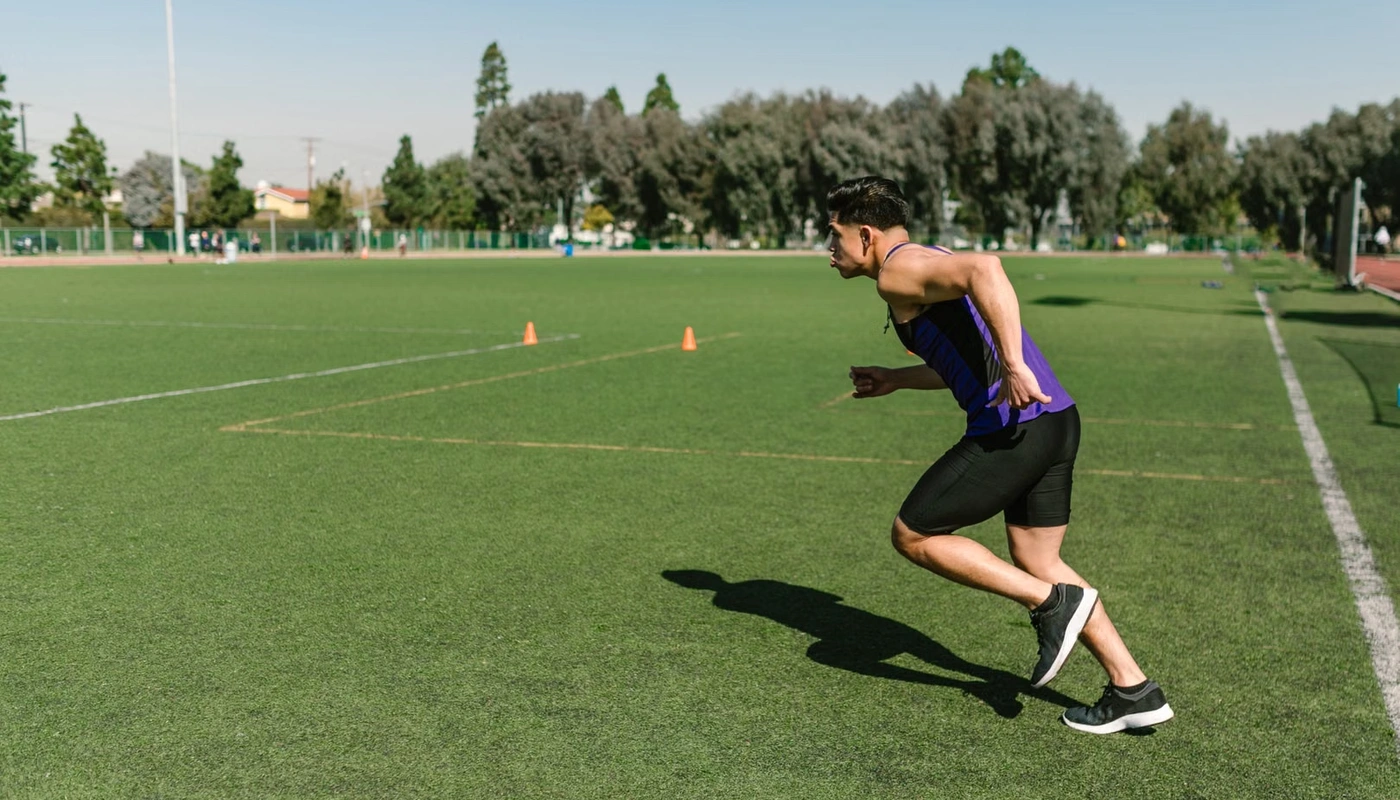
Athlete practising acceleration mechanics during sprint training
Acceleration Focus Win the first 5–10 metres.

Efficient projection, force application and sprint mechanics can help players create separation and react faster during decisive football actions.

Sprint Mechanics for Better Acceleration

Acceleration is not just about trying harder. It depends on body position, force application, arm action and front-side mechanics. . If an athlete cannot project the body effectively and apply force into the ground, the first steps become weaker and slower.

In football, those first few metres often decide who reaches the ball first, who escapes pressure and who wins key duels. Improving sprint mechanics helps players become more efficient, explosive and confident in transition moments.

  • Forward body lean: helps direct force horizontally in the early acceleration phase.
  • Strong shin angle: supports better projection and pushing mechanics off the ground.
  • Arm drive: improves rhythm, coordination and power through the first steps.
  • Ground force application: teaches athletes to push properly rather than just spin the legs.
  • Step efficiency: cleaner mechanics can improve speed without wasting movement.

In my coaching, acceleration work is built progressively through drills, sprint positions, resisted work, technical feedback and structured strength training so the athlete can transfer it into real football actions.
Physical Qualities

How Strength & Power Improve Acceleration

Sprint technique matters, but technique needs physical capacity behind it. Footballers must be able to produce force quickly and direct that force effectively into the ground. Strength and power training can support these qualities when they are programmed alongside actual sprinting.

01

Build a Strength Base

Stronger athletes have greater potential to produce force during acceleration. Exercises such as squats, split squats, deadlift variations and hip-dominant movements can build the lower-body strength required to support powerful sprint actions.

02

Produce Force Quickly

Football does not give players unlimited time to generate force. Jumps, explosive lifts, throws and other power-focused exercises can help develop the ability to express strength at higher speeds.

03

Train One-Leg Force Production

Sprinting is a repeated single-leg action. Unilateral strength work can help develop force production, control and left-to-right capacity while complementing bilateral strength exercises.

Important

Getting stronger does not automatically make a footballer faster. Strength and power create useful physical qualities, but players still need regular sprint exposure and technical practice to learn how to express those qualities at speed.

Practical Training

Practical Acceleration Drills for Footballers

Acceleration drills should have a clear purpose. Rather than collecting dozens of exercises, use a small number of drills to reinforce projection, force application, rhythm and explosive first steps, then progress into high-quality sprinting.

01

Wall Acceleration

Position

A simple drill for teaching the athlete how to organise the body during early acceleration before adding full-speed movement.

Focus

Maintain a strong body line, active hip position and appropriate shin angle while driving into the ground.

Coaching Cue

Push the ground away rather than lifting the feet quickly without producing useful force.

02

Falling Start

Projection

The athlete gradually leans forwards until balance is lost, then accelerates aggressively into the first few steps.

Focus

Encourage natural forward projection and a committed first push into the ground.

Coaching Cue

Avoid standing upright immediately. Let the body rise naturally as speed increases.

03

5–10 Metre Accelerations

Speed

Short maximal-effort accelerations allow players to practise the exact quality that matters during many football actions.

Focus

Explosive first steps, aggressive arm action and high-quality intent on every repetition.

Coaching Cue

Give enough recovery between repetitions so the session remains speed training rather than conditioning.

04

Resisted Acceleration

Resistance

Sleds, bands or other appropriate resistance can add an overload to the acceleration pattern when used carefully.

Focus

Reinforce forceful pushing while keeping the athlete's movement pattern recognisable as sprinting.

Coaching Cue

Resistance should support the purpose of the drill, not become so heavy that sprint mechanics completely change.

Coaching Principle Quality before quantity.

Speed work should be performed with intent and appropriate recovery. Once sprint quality drops significantly, adding more repetitions can turn a speed session into fatigue work rather than improving acceleration.

Avoid These Errors

Common Speed Training Mistakes Footballers Make

More sprinting does not automatically mean better speed development. Footballers need enough intensity to create an adaptation, but also enough recovery, technical quality and progression to perform the work properly.

01

Turning Speed Work Into Conditioning

Performing sprint after sprint with very short recovery quickly reduces velocity and movement quality. The athlete may feel exhausted, but the session is no longer developing maximum speed effectively.

Better Approach

Use appropriate recovery between high-intensity efforts so each important repetition can be performed with genuine speed.

02

Only Using Ladder & Cone Drills

Fast feet around cones can have a place in warm-ups or coordination work, but they do not replace sprinting at high velocity or developing the force qualities required for acceleration.

Better Approach

Keep drills purposeful, but make sure footballers also accelerate and sprint through real space.

03

Ignoring Strength & Power

Sprint mechanics matter, but athletes also need the physical capacity to produce and tolerate high forces. Technical work alone may not address every limitation affecting acceleration.

Better Approach

Combine sprinting with progressive strength and power work based on the player's needs and training history.

04

Training Speed When Already Fatigued

Placing the most important sprint work after a large conditioning block or exhausting gym session can reduce the quality of the accelerations the player is capable of producing.

Better Approach

When speed is the priority, perform it while the player is appropriately warmed up but relatively fresh.

The Main Point Speed training should look like speed training.

High intent, good mechanics and sufficient recovery are more useful than simply making a player tired. The goal is to improve the quality of the movement first, then build the programme around the demands of football.

Weekly Programming

How Often Should Footballers Train Speed?

There is no single number that suits every player. Speed training has to fit around football sessions, match exposure, recovery, training age and the athlete's individual needs. The aim is to expose the player to high-quality sprinting often enough to develop it without creating unnecessary fatigue.

01

Prioritise Quality

One high-quality exposure can be more useful than several tired sessions. Sprint work should normally be performed when the player is appropriately warmed up and capable of producing genuine speed.

02

Use Football Exposure

Team training and matches already contain accelerations and sprints. Extra speed work should complement those demands rather than simply adding more running because the programme says so.

03

Adjust to the Player

A player returning from reduced training, a substitute with limited match minutes and a regular 90-minute starter may need different weekly speed volumes.

Example Structure

Speed Within a Match Week

Example only • Saturday match
MD-4 Strength

Main lower-body strength work with controlled total volume.

MD-3 Speed Exposure

Acceleration and sprint work performed with high intent and recovery.

MD-2 Power / Football

Lower-volume explosive work alongside tactical football demands.

MD-1 Prime

Keep volume low. Focus on readiness rather than creating fatigue.

MD Match

Competitive speed exposure depends on position, minutes and match context.

MD+1 Recover / Top-Up

Recovery for high-minute players; individual top-up work may differ for others.

This is not a fixed programme. Match minutes, team training intensity, fixture congestion, injury history and the player's current physical capacity should all influence how speed work is placed.

Long-Term Development

How to Progress Speed Training

Progression does not simply mean adding more repetitions every week. Footballers should gradually develop the ability to produce better-quality acceleration under increasingly demanding conditions while maintaining good mechanics and high intent.

01

Build the Positions

Early training can focus on understanding body position, projection, arm action and how the athlete applies force during the first steps.

Example Progression

Wall drills → controlled starts → short accelerations with technical feedback.

02

Increase Sprint Intent

Once movement quality is established, players need genuine sprint exposure. Speed improves through performing fast movements, not only through low-intensity technical drills.

Example Progression

Controlled 5m starts → maximal 5–10m efforts → longer acceleration distances.

03

Add Appropriate Overload

Resistance, strength work and power training can progressively challenge force production without replacing the need for normal high-quality sprinting.

Example Progression

Bodyweight acceleration → light resisted work → individualised resistance and power exposure.

04

Transfer It to Football

Straight-line acceleration creates an important physical foundation, but football also requires players to react, reposition and accelerate from different starting situations.

Example Progression

Predetermined starts → reaction cues → football-specific competitive actions.

Progression Principle Progress the challenge, not just the volume.

More repetitions are not automatically better. Progress can come from better sprint quality, increased intent, different starting positions, slightly longer distances, appropriate resistance or more demanding decision-making while maintaining the purpose of the session.

Football Performance Coaching

Speed Is a Quality That Can Be Trained

Becoming faster is not about collecting random sprint drills. Footballers need a structured approach that develops acceleration mechanics, strength, power, sprint exposure and match-specific movement while managing fatigue across the week.

Develop Acceleration & sprint mechanics
Build Strength & explosive power
Transfer Speed to football